 Skip to main content
Secure Remote Access for IoT & M2M Devices
Access, monitor and manage remote devices with cellular connectivity built around your network; including private APNs, VPN connectivity, L2TP and fixed private or public IP addressing.
Your devices may be remote. Your control shouldn't be.
Getting an IoT device connected is only part of the job.
When a router, camera, controller, gateway or machine is deployed miles away, your technical teams may still need to reach it. Your applications need to know where to find it. Your security policies need to control where its traffic can go. And if the underlying mobile connection changes, your wider network shouldn't have to be rebuilt around it.
At Cellhire, we provide remote access solutions for your device.
We combine resilient cellular connectivity with private APNs, fixed private and public IP addressing, L2TP, IPsec and secure VPN access to create the right communication path between your devices and the systems that manage them.
Remote solutions designed around your network


Remote access isn't one product. It's an architecture.
Different IoT applications need very different ways of communicating.
- A security company may need to access a camera on demand.
- An engineering team may need to remotely diagnose equipment at an unmanned site.
- A business may want its cellular routers and gateways to communicate directly with its existing network or cloud infrastructure.
Another application may rely on a persistent IP address for whitelisting, or remote administration. Trying to solve every one of those requirements with a standard consumer or mobile broadband SIM can create unnecessary complexity.
Cellhire gives you the building blocks to design connectivity around how your devices need to communicate.
A private Access Point Name gives your IoT estate a dedicated connectivity environment, providing greater control over how cellular traffic is separated and routed.
Rather than treating each device like a conventional consumer internet connection, a private APN can form part of a controlled network architecture connecting your devices to the systems that need them.
Cellhire offers private APN options within its IoT connectivity proposition.
Ideal for: CCTV, industrial IoT, telemetry, connected infrastructure, sensitive data and large distributed device estates.
Give each remote device a stable private IP address that remains consistent rather than relying on dynamically allocated addressing.
That makes devices easier to identify, whitelist and manage and enables them to form part of a controlled private network architecture.
Our Fixed Private IP SIMs are designed specifically for IoT and M2M applications requiring persistent addressing and remote management.
Ideal for: remote diagnostics, cameras, routers, industrial gateways, monitoring equipment and applications requiring persistent device addressing.
Connect your cellular estate securely to your corporate network, data centre or cloud environment using an encrypted VPN.
An IPsec VPN can provide a protected path between networks, allowing IoT traffic to reach the systems it needs without requiring every individual device to be directly exposed to the public internet.
Cellhire includes IPsec tunnelling and secure remote VPN access within its IoT capabilities.
Ideal for: enterprise networks, corporate data centres, cloud environments and security-sensitive applications.
Need cellular devices to integrate more closely with your existing LAN or cloud architecture?
Our L2TP-enabled IoT connectivity can extend cellular 4G and 5G connectivity into your network while giving you greater control over how traffic is routed.
It can also maintain consistent IP addressing across network switches, support static IP routing during failover and integrate with RADIUS authentication.
For the right network architecture, that means a device connected over cellular can behave much more like part of your existing infrastructure.
Ideal for: enterprise network extension, resilient WAN, managed service providers, complex routing requirements and applications dependent on consistent IP addressing.
Some applications need a consistent, publicly routable endpoint.
A fixed public IP gives the connection a persistent public address, which can enable authorised inbound connectivity where the application and service configuration require it.
Cellhire offer fixed public as well as private IP options within its IoT connectivity portfolio.
Public addressing should always be chosen deliberately and protected with the appropriate firewall, authentication and access-control measures.
Ideal for: selected legacy systems, remote routers, specialist CCTV architectures and applications that specifically require a persistent publicly reachable address.
Which remote access solution do you need?
| What you need | Potential architecture | What it gives you |
|---|---|---|
| Keep devices privately addressable | Private APN + fixed private IP + VPN (IPSec or SSL) | Persistent addressing inside a controlled private network |
| Connect IoT devices to your corporate environment | Private APN + IPsec VPN + Private IP | Encrypted network-to-network connectivity |
| Extend cellular devices into a LAN or cloud environment | IPSec VPN + private addressing | Greater routing control and network integration |
| Reach an endpoint through a consistent public address | Fixed public IP, IPSec VPN & SSL VPN with private IP | Persistent publicly routable addressing |
| Maintain IP-dependent services during failover | L2TP + static addressing | Greater addressing consistency when connectivity changes |
| Control a large distributed SIM estate | IoT connectivity + Portal | Centralised visibility, management and diagnostics |
Where can Cellhire remote access solutions be used?
Remote security devices often need to operate in locations where fixed connectivity is unavailable while still allowing authorised teams to view footage, diagnose faults and manage equipment from elsewhere.
Private APNs, persistent addressing and VPN connectivity can provide a controlled architecture for accessing distributed CCTV and security estates.
Factories, plants and industrial sites increasingly rely on connected gateways, monitoring systems, machines and controllers.
Remote access can give authorised engineering teams a route to diagnose and manage connected equipment without requiring an engineer to be physically present at every location.
Stores depend on connectivity for payments, inventory systems, security, digital signage and operational technology.
Fixed addressing and managed cellular routing can make distributed equipment easier to integrate with central IT systems while multi-network connectivity helps maintain service across different locations.
Cellular connectivity can provide an alternative WAN path when fixed infrastructure is unavailable, delayed or temporarily offline.
Where applications depend on IP consistency, our L2TP solution can maintain addressing during failover and reduce the reconfiguration required when connectivity switches.
A connected display, kiosk or terminal doesn't only need to receive data. Operators need to monitor hardware, update content, troubleshoot equipment and remotely access connected routers or gateways.
Our SIM and router solution can be configured with remote-access options to support remote device management.
Pumps, substations, telemetry equipment, environmental sensors and other infrastructure can be deployed in locations that are difficult or expensive to visit.
Reliable cellular connectivity and remote-access architecture can allow teams to collect data, monitor equipment and investigate faults without making every issue a site visit.
From construction sites and temporary offices to unmanned infrastructure, cellular routers frequently become the gateway between remote equipment and central systems.
Our IoT SIM and router bundles combine multi-network connectivity with configurable remote-access options.
Security starts with choosing the right route
A secure IoT deployment isn't created by one feature alone.
The architecture needs to consider:
- Does the device need to be publicly reachable at all?
- Who should be able to initiate a connection?
- Does the device require a persistent IP address?
- Should traffic terminate in your LAN, data centre or cloud environment?
- Which systems should be able to communicate with the device?
- Does traffic between networks need to be encrypted?
- Which firewall, authentication and access-control policies need to apply?
We provide a range of networking options to build around those requirements, including private and public IP addressing, private APNs, L2TP, IPsec tunnelling and secure remote VPN access.
- Private IP doesn't automatically mean encrypted
Private addressing can control how endpoints are addressed and exposed, but encryption is a separate consideration. Where encrypted network-to-network communication is required, an appropriate VPN architecture such as IPsec can form part of the solution.
- Public IP doesn't have to mean unrestricted
A fixed IP provides consistent public addressing. It should still be protected by appropriate firewall rules, authentication, access controls and application security.
- L2TP and IPsec solve different problems
They shouldn't be treated as interchangeable terms. Our L2TP service is designed around cellular network extension, routing control and consistent addressing, while IPsec VPN provides encrypted connectivity between networks.
Keep control of your entire SIM estate with SIM Management Portal
Remote access to the device is one part of managing distributed IoT. You also need visibility and control over the connection itself.
With our SIM Management Portal, teams can centrally manage IoT connectivity across their device estate.
Monitor usage, manage SIMs and alerts, and maintain visibility across thousands of distributed connections from one platform.
So, when a device stops communicating, your first action can be investigation rather than sending someone to site.
Explore SIM Management Portal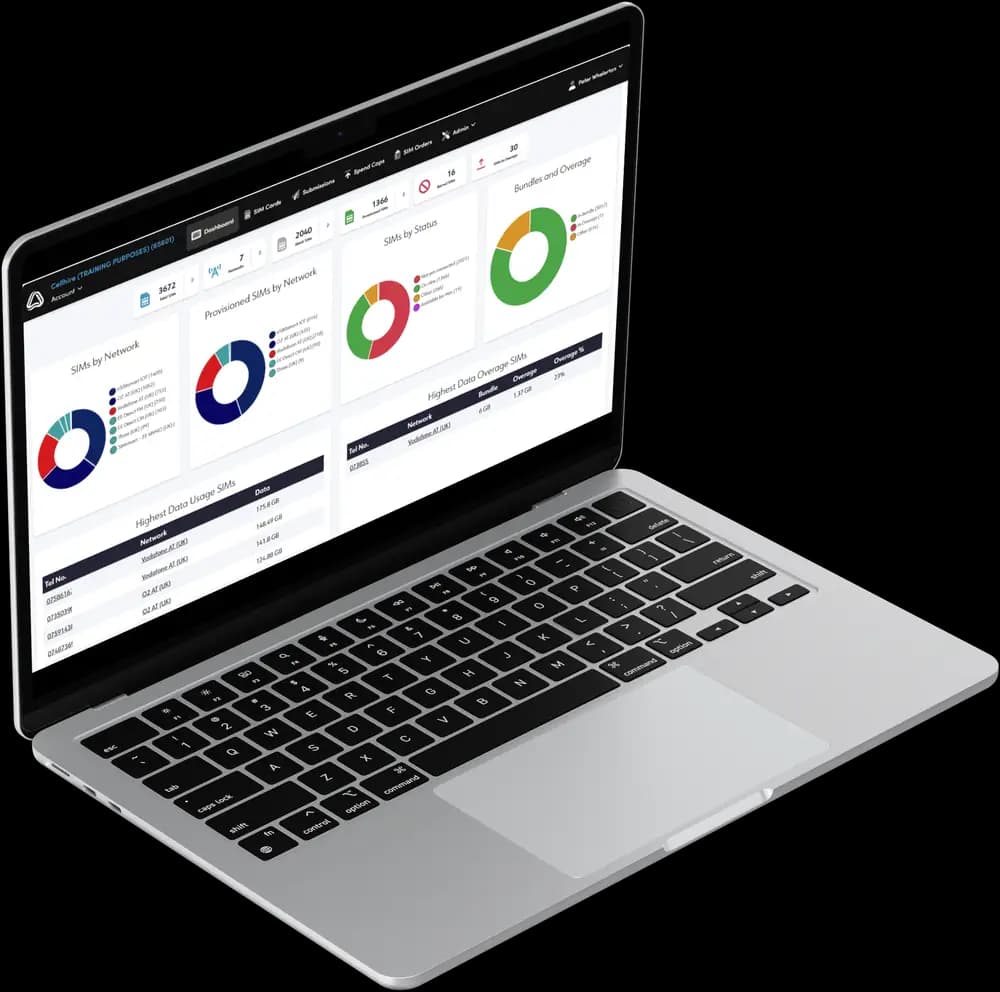
2,200+ remote connections. One centrally managed estate.
When a nationwide paint retailer needed to connect more than 2,000 network-enabled paint-mixing machines, its existing single-network approach was creating coverage, visibility and cost challenges.
We deployed 2,200+ multi-network IoT SIMs, supported by its SIM management platform and fixed-IP connectivity for secure remote access.
The result?
- 2,200+ SIMs deployed
- £60,000+ annual connectivity saving
- Automated network switching
- Fixed-IP connectivity for secure remote access
- Real-time visibility across the SIM estate
- Expansion across the UK, Ireland and EU under the same connectivity solution

Why choose Cellhire for IoT remote access?


Built for IoT
Connectivity designed around remote devices, machines and distributed infrastructure rather than consumer handsets.
Flexible IP architecture
Choose private or public IP addressing according to the needs of the application.
Enterprise network integration
Build around private APNs, L2TP, IPsec VPN connectivity depending on where traffic needs to go and how it needs to be protected.
Multi-network resilience
Access EE, O2, Vodafone and Three through our UK multi-network IoT connectivity.
Global reach
Connect IoT deployments across 400+ networks in 185 countries.
Centralised management
Manage distributed connectivity through our SIM Management Portal.


IoT expertise at scale
From individual remote devices to deployments containing thousands of SIMs, we can support connectivity through rollout and ongoing management.
Ready to take control of your remote devices?
Tell us what you're connecting, where your devices are deployed and how your teams or applications need to access them. We'll help you build a remote-access solution around the requirements of your network, balancing reachability, security, resilience and control.
Request a Remote Access ReviewGetting started with Cellhire
Tell us what needs to connect
We'll look at your devices, applications, deployment locations and remote-access requirements.
Define the architecture
Identify the appropriate combination of cellular connectivity, IP addressing, private APN, L2TP and VPN integration.
Configure and test
Validate connectivity, coverage, routing and access requirements before wider deployment.
Deploy and manage
Roll out connectivity across your device estate and manage it centrally through SIM Management Portal.
Frequently Asked Questions
Remote access allows authorised systems, applications or technical teams to communicate with an IoT device from another location.
Depending on the application, that could mean retrieving data, viewing a camera feed, diagnosing a router, changing configuration or managing equipment without travelling to the physical site.
The important question isn't simply whether a device has an internet connection. It's how the communication path to and from that device is designed and controlled.
An APN, or Access Point Name, determines how a cellular device connects to a data network.
A private APN provides a dedicated environment that can give an organisation greater control over how its IoT traffic is separated and routed.
Yes. Our IoT portfolio includes fixed private and public IP options, while also offering static private and public IP addressing.
A fixed public IP is useful where a consistent publicly routable address is specifically required. Appropriate access controls and security should still be applied.
A private IP is used within a private addressing environment and isn't directly publicly routable in the same way as a public internet address.
A public IP provides an internet-routable address.
Which option is appropriate depends on whether the device needs inbound connectivity, where traffic must terminate and the security architecture surrounding the deployment.
Yes. The IP will stay the same regardless of what network the SIM roams onto by default. L2TP will enable the IP to stay the same if there is a failover from the fixed line to cellular.